
The temporary relief that Australian homeowners have enjoyed up to 2025 is over. After delivering three consecutive rate cuts last year, offering genuine breathing space for household budgets, the RBA has now reversed course. Two hikes in quick succession have reset the conversation entirely, and more may be on the way. If you hold a mortgage, understanding where home loan interest rates stand and where they could go next is no longer just part of consideration, It is essential. This guide gives you a clear, data grounded picture of the current environment, what is driving it, and the moves worth considering now.
Where Home Loan Interest Rates Stand Right Now
The RBA raised the cash rate by 25 basis points to 4.10 percent at its March 2026 meeting in a split vote, and this was influenced by intense inflationary pressures in the second half of 2025. This follows the same pattern of increase at the February meeting and signifies the end of the easing cycle that has seen the cash rate fall from 4.35% to 3.60%.
One difference that can be easily lost in a headline is that the RBA cash rate and your mortgage rate, which are not the same. Lenders decide independently on whether, when and the extent to which to increase their rates, and in practice, most big banks have already implemented both increases in full. NAB, CBA, ANZ, Westpac and Macquarie all have confirmed that they have raised their variable home loan rates effective by the end of March 2026.
What the Big Four Banks Are Forecasting
When the country’s four largest lenders all land on the same prediction, it carries real weight. At the meeting on May 5, ANZ, CBA, NAB, and Westpac are all forecasting further increase of the cash rate by another 25 basis points. This will bring the cash rate to 4.35%, in line with the high end of the last tightening cycle.
This is a remarkable shift. In the recent past, till mid 2025, the same institutions had been projecting rate cuts extending to 2026. The shift has been rapid. Whether May delivers another hike or not, the broader message from the banks is the same, the era of falling rates appears to be on pause for now.
RBA Governor Michele Bullock has also made clear that the board is not waiting passively for quarterly inflation data before acting. Every meeting, she has said, is live. That means May is genuinely in play regardless of how the April CPI numbers land.
What Is Keeping Rates Elevated
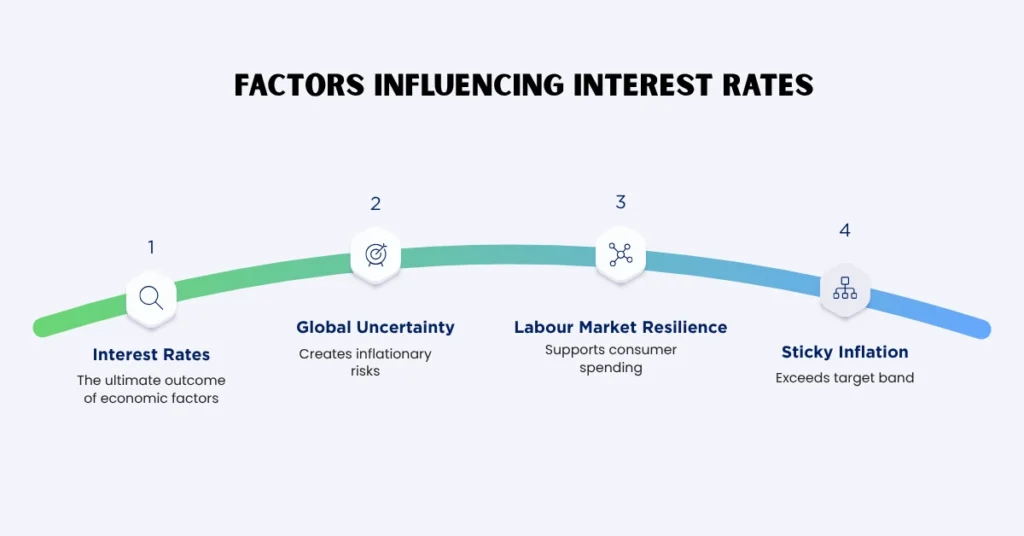
There are three main factors impacting rates and they are not looking favourable at least in the short term.
1. Inflation has proved stickier than the RBA expected
The March hike was driven by a broad set of data pointing to renewed inflationary pressures in the second half of 2025, with the board noting stronger capacity constraints than previously assessed. The RBA’s own forecasts now show inflation remaining above the 2 to 3% target band through 2026. And current prediction shows it to return to the preferred range mid of 2028.
2. The labour market has remained resilient
Strong employment reduces the economic pressure on the RBA to cut rates, as consumer spending continues to hold up. The argument about reducing rates becomes more difficult when individuals continue working and spending money.
3. Global uncertainty is adding an inflationary premium
Conflict in the Middle East, persistent supply side pressures, and volatile energy markets all create upside risks to domestic inflation. Market expectations currently factor in the possibility of another two rate increases before the end of 2026.
Understanding Home Loan Interest Rates Calculation and Your Repayments
Numbers on a page become real when you translate them into monthly dollars. Understanding how home loan interest rates calculation work helps you see the true impact of even small rate movements on your budget.
Interest on your mortgage is calculated daily and charged monthly against your outstanding balance. As you pay down principal, the interest component of each repayment gradually shrinks. The standard formula spreads both principal and interest across your full loan term, which is why even a 0.25% change can feel significant over a 25 or 30 year horizon.
Fixed vs. Variable: Which Makes More Sense in 2026
This is the question homeowners ask most, and there is no universal answer, but the current environment does sharpen the trade offs.
Variable rates move with the market. If the RBA eventually cuts again, variable borrowers will benefit automatically without refinancing. Most economists agree to cuts will happen eventually, just not yet. However, the downside is you are exposed to further rises in the near term according to the current market conditions.
Fixed rates offer certainty. You know exactly what you owe each month, which makes budgeting cleaner. However, most fixed loan products costs more than variable rates. Lenders price in inflation risk, so you might lock in a rate higher than current variable rates.
An alternative worth considering is a split loan, a combination of a fixed and a variable loan, which will provide you with some protection against an additional increase, along with flexibility. The right structure is based on your level of income stability, the loan size and the risk tolerance. It is not a one size fits all choice, which is why it is worth speaking with a broker before making a decision, especially if there are considerations of selling property or refinancing to take equity out etc.
What Homeowners Should Do Now
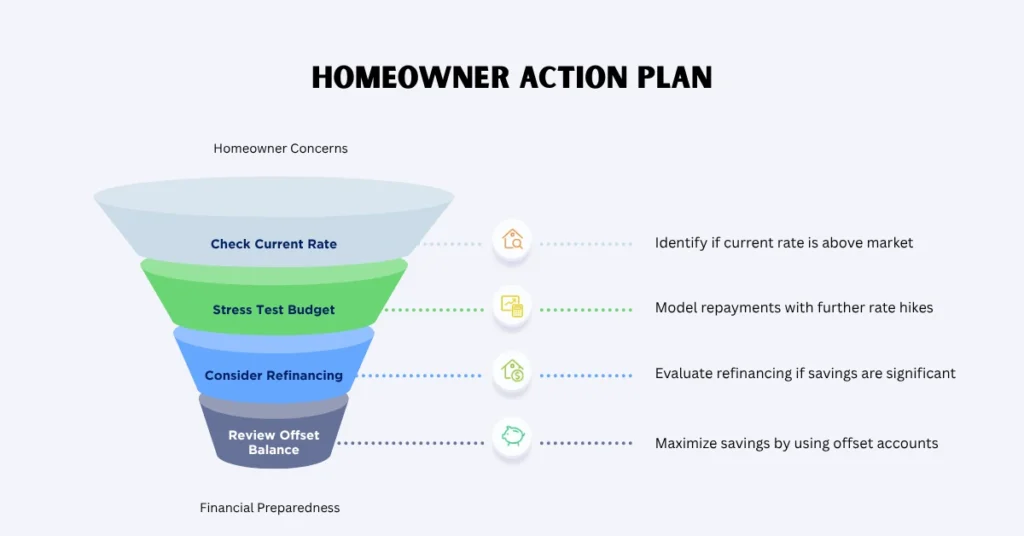
Planning and Strategy matters more than ever before. Current home loan interest rates are elevated, but that does not mean you are without options. These four steps are worth acting on before the May meeting.
1. Check your actual rate today
Many borrowers are sitting on rates well above what is available in the market. Loyalty to a lender rarely pays off, competitive pressure between lenders means a simple repricing conversation can sometimes deliver a meaningful reduction without a full refinance.
2. Stress test your budget against further rises
Model your repayments considering 2-3 more rates rise. If these newly calculated numbers create genuine pressure, that is a signal to act now rather than after another hike lands.
3. Consider refinancing if the numbers stack up
As a general guide, securing a rate at least 0.50% lower than your current home loan interest rates can recoup the within 12 to 18 months on most standard loan sizes. The savings can be meaningful over a 30 year term.
4. Review your offset or redraw balance
With rates elevated, every dollar sitting in an offset account is working harder than it would in a savings account for most borrowers. Make sure your loan structure allows you to maximise this.
How Nepean Mortgage Can Help You Navigate 2026
At Nepean Mortgage, we deal with homeowners in Western Sydney as well as throughout Australia, who are struggling to make sense of a fast paced market. Whether you are asking yourself if you are still getting a good deal with your current home loan interest rates, considering refinancing or simply deciding whether to fix part of your loan, we provide clear, practical guidance in what can often feel like a complex market.
Conclusion
Home loan interest rates in Australia are sitting highest in the last decade, and immediate outlook suggests they may climb further before they fall. Two hikes in 2026 have already added real pressure to household budgets, and the big four banks are unanimous in expecting at least one more. Inflation, a tight labour market, and global uncertainty are all pointing in the same direction, and the RBA has shown it is willing to act on that signal.
The one thing worth remembering is that a return to the near zero rates of the pandemic era is not part of any credible forecast. The question is not whether things will eventually ease. They will, but how do you position yourself well in the meantime. That is a question worth answering with the right information and, ideally, the right advice.
FAQs
Will home loan interest rates decline in 2026?
The RBA has increased the rates in February and March, and all four major banks are predicting a further increase in May. Relaxation will probably rely on a prolonged drop in Q1 and Q2 inflation statistics. However current data do not signal any immediate rate cut.
What impact would the RBA cash rate have on my mortgage repayments?
When the RBA increases the cash rate, the majority of the lenders will transfer the increment to the variable rate borrowers within a few weeks. Every increase of 0.25 percent will increase an average of $90 to $100 per month on a loan of $600,000 over 30 years. Loans that are fixed are not affected until the fixed period has passed.
Should I refinance my home loan now?
If your current rate has not been reviewed recently, you may be paying well above what is available. As a rough guide, a 0.50% or greater improvement over your existing rate typically recovers refinancing costs within 12 to 18 months on most standard loan sizes.
How is home loan interest rate calculation done on a standard mortgage?
Interest is calculated daily on your outstanding balance and charged monthly. As your principal reduces over time, the interest portion of each repayment shrinks. The MoneySmart mortgage calculator is a reliable starting point for modelling different rate scenarios.
Should I fix my rate before the May RBA decision?
It depends on your circumstances. Most fixed products currently sit above variable rates. If budget certainty matters more than flexibility right now, fixing part of your loan is worth exploring with a broker before the next RBA meeting.


