
Home loan refinancing is an excellent financial idea. It may reduce your monthly payments, enable you to tap into equity to make improvements in your home or consolidate debts or provide you with the opportunity to enjoy more flexible loan terms. However, there may be hidden costs of refinancing with some lenders and such hidden costs can easily outweigh the benefits of refinancing if not considered properly.
At times financial institutions use lower interest rates to capture the attention of homeowners, only to discover later that they have been charged fees and made to pay practically what could have served as savings. These costs will impact their savings, but sometimes outweigh the actual purpose. Hence, here at Nepean Mortgage, we believe it is very important to know the pros and cons of any financial product so we can compare apples to apples and find the loan product suits you best with overall lower cost features you need instead of looking at just the headline figure.
Why Does Refinancing Matter
When you refinance, you will find hidden costs of refinancing beyond the advertised interest rate. Some are obvious, like application fees or government charges, but others can be easy to overlook.
- Charges from your current lender to close your loan
- Fees from your new lender to set up the loan
- Government and legal costs to update property records
- other costs like LMI if your equity is low
Unless you consider them, the money you will save by changing your lender may be considerably less (or even negative), at least in the short run.

Common Expenses in Refinancing a Home Loan in Australia
The following is an estimation of the typical cost of refinancing a home loan in Australia that you can incur:
1. Costs from Your Current Lender
These are fees you may pay to exit your existing loan:
a. Mortgage Discharge Fee:
It is approximately 350-500 dollars to close your existing mortgage formally.
b. Fixed-Rate Break Fees:
In case you have a fixed-rate loan and break it earlier than the end of the term, then your lender might impose a break fee. This can be significant depending on how much time is left and how interest rates have shifted.This is why we like to check with our clients if they have plans to sell or any significant upcoming changes before we refinance.
c. Early Exit Fees:
For variable loans opened after 2011, these are generally no longer charged. Older loans may still attract them.
2. Costs from Your New Lender
When you take out a replacement loan, these are the usual charges:
a. Application or Establishment Fee:
It can be from $300 to $600 depending on lenders, while others may waive this fee in an attempt to lure new clients.
b. Property Valuation Fee:
There are lenders who offer this as part of service while others may charge up to $ 600 to find out the value of your home, according to the type and location of the property. Please note for rural or speciality properties this cost can be significantly higher.
c. Settlement and Legal Costs:
This covers legal processing and updating property titles. Some lenders have account-keeping fees or charges for features like offset accounts and redraw facilities. These aren’t always upfront, but they impact your total cost.
3. Government and Legal Fees
These are unavoidable government fees for refinancing home loan costs, which include updating property records:
a. Mortgage Registration Fee:
This is an expense of the state government (e.g., around $160 to $170 in NSW; each state has different prices).
b. Title Search Fee:
It is a small fee (around $50-$100) to verify the ownership of the property.
c. Legal Fees:
This includes document processing, updating of property titles and compliance with the regulations. Fees vary by lender and loan complexity, so check before refinancing.
4. Lender Mortgage Insurance (LMI)
If your Loan-to-Value Ratio (LVR) is above 80, then there is a good chance you might have to pay Lender’s Mortgage Insurance (LMI). This protects the lender if you have low equity. However with the increased competition and more lenders coming to market than ever before some lenders do not charge LMI/risk fee up to 85 or 90% LVR.
A key point many homeowners miss is that LMI is not always transferable. Even if you paid it on your original loan, most lenders require a new policy if your equity is still below 20%. Depending on your LVR and loan size, LMI can stack up to thousands of dollars.
This is one of the biggest hidden costs of refinancing your loan and can significantly affect your savings.
Why These Costs Affect Your Savings
Even if you secure a lower interest rate, the upfront costs, especially when combined, may delay your financial benefit. Hence,It is important to know your break even point before you refinance. Correctly calculating this helps you avoid the hidden costs of refinancing when it doesn’t make financial sense.
Break-Even Point: What It Means
The break-even point informs you of the period taken by your monthly savings to cover all the hidden costs of refinancing.
Break-even (months) = Total Upfront Costs ÷ Monthly Savings
Calculating this helps you avoid refinancing if you plan to sell or move before reaching that point. A broker can make this calculation simple and accurate, including all fees, LMI, and government charges.
Role Of A Mortgage Broker
A good broker acts as an experienced guide, not a salesperson, helping you make decisions that fit your financial goals.
They will help:
- Understand which fees apply to your situation
- Compare lenders not for just rate but also features and cost associated
- Runs through Pros and Cons so you can make informed decisions, including break-even point
Real-Life Case: Finding the Break-Even Point
Sarah wants to refinance the mortgage of $500,000. Also, she is interested in decreasing the monthly repayment, which includes all the costs of refinancing a mortgage.
| Cost Type | Amount (AUD) | Notes |
| Discharge Fee | $350 | From the outgoing lender |
| Application Fee | $400 | New lender |
| Property Valuation | $400 | Required by the lender |
| Mortgage Registration Fee | $160 | NSW fee |
| LMI | $0 | Sarah has 25% equity, so no LMI is required |
- Total upfront costs: $1,310
- Monthly savings: $150
- Break-even point: Around 9 months
Using the services of a mortgage broker such as Nepean Mortgage, Sarah is confident that she will account for all the costs that are hidden, and she will be aware when refinancing would commence to save her money.
Example 2: High LVR Scenario
Mark has a $400,000 mortgage but only 14% equity. He wants to refinance, but the hidden costs of refinancing the loan are significant in his case. It is through a broker that these costs can be identified early enough, and therefore, homeowners such as Mark can make a decision.
Common Refinancing Pitfalls
Even with a lower interest rate, homeowners can fall into traps if they don’t account for all costs:
- Term Resets: Switching to a new 30-year loan after paying for several years can increase total interest. Match the new term to your remaining balance.
- Considering Interest Rates only: You should check the comparison rate, as the lowest headline rate may hide fees or lack important features.
- Ignoring LMI: Lenders may require new insurance if your equity is below 20%.
- Unaccounted Government and Legal Fees: This includes small fees like registration or title searches.
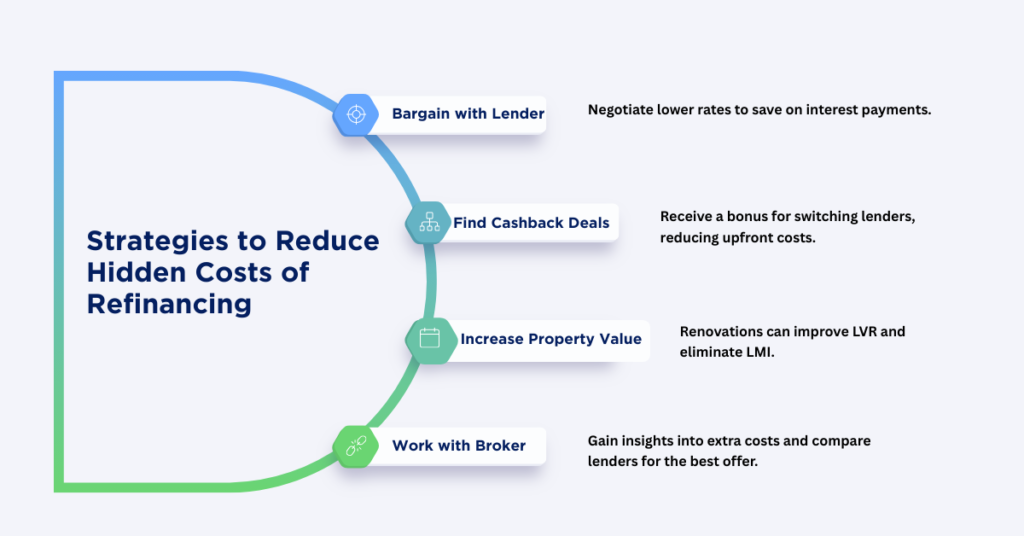
Strategies to Reduce Hidden Costs
- Bargain with your existing lender: Most of them will offer lower rates in order to keep your business.
- Find cashback deals: There are lenders who give out $2,000-4,000 for a change of ownership.
- Increase property value: Renovations would give you a better LVR and lessen or eliminate LMI.
- Work with a broker: You can get to learn the extra costs that can be ignored, compute the break even points, and compare different lenders with the best overall offer(s) through a broker.
Final Thoughts: Why choose Nepean Mortgage?
Refinancing can conserve funds and enhance cash flow, however, only when you consider the hidden costs of refinancing your loan. By using a trusted mortgage broker such as Nepean Mortgage Company, you will be:
- Informed of all initial and current expenses.
- Eliminate costly errors such as a reset of the term or unnecessary LMI.
- Getting a loan best suits your unique situation.
In case you are considering refinancing, consult with Nepean Mortgage and request an individual evaluation. We will review your financial position carefully, helping you to make informed and smart decisions.
Disclosure: Above information doesn’t take your financial status into account, it is general guidance only. Fees and rates and lender policies may be different. Consult a mortgage broker for advice prior to refinancing.
FAQs
What are the hidden costs of refinancing your loan in Australia?
The unwarranted expenses of refinancing your loan can consist of discharge costs, assessment fees, attorney fees, mortgage registration charges, and potential break expenses on the fixed rate loans.
How do you know if refinancing is worth it or not?
One easy method of doing this is to find out your break-even point, by calculating what length of time it will take before your monthly savings will cover your refinancing fees. Also, you should consider refinancing when your savings exceed your initial expenses.
Do I have to pay LMI once more when refinancing?
Yes,it is possible depending on lenders, your loan size and LVR. Most of the lenders will charge LMI for over 80% LVR.
Is it possible to refinance without any fees or charges?
While there will be some government and legal charges that are mandatory, others can be avoided. However, at times lenders have cashback or fee waiver packages that can not only meet the refinancing expenses but also allow you to put some money in your back pocket .Nevertheless, refinancing always needs to be considered with overall flexibility, loan term, rate, repayment and your personal situation instead of just looking at cost.
Is it advisable to seek the advice of a mortgage broker before refinancing?
Mortgage brokers will educate you about actual costs of refinancing and the benefits it can bring to the table, they will match the right lenders to your unique situation and help you to make informed decisions.
