
When applying for a loan whether it is a home, automobile, education, or business, you will come across one important question: what type of interest rate?
The two most common types of interest rates are fixed interest rate and variable interest rate. Interest rates does not only impact the amount you pay but also come with different features. So, it is important to know which one is right for you. In this blog, we will discuss fixed vs variable interest rates, and which suits you better for your needs.
What is a Fixed Interest Rate?
The fixed interest rate is an interest rate that will not alter during the fixed term of the loan, giving you certainty of repayment amount during the term of the loan. Once the fixed term ends then the loan reverts to variable for the rest of the loan term, unless you fixed the loan again. Most of the lenders offer fixed loans for various loan products and most common terms are for 1,2,3 and 5 years.
Features of Fixed Interest Rate
- Stability: Fixed interest rate is stable; it will keep you protected from rate rises that can happen in near future.
- Predictability: Repayments amount will stay the same during a fixed period so you can plan your finances better.
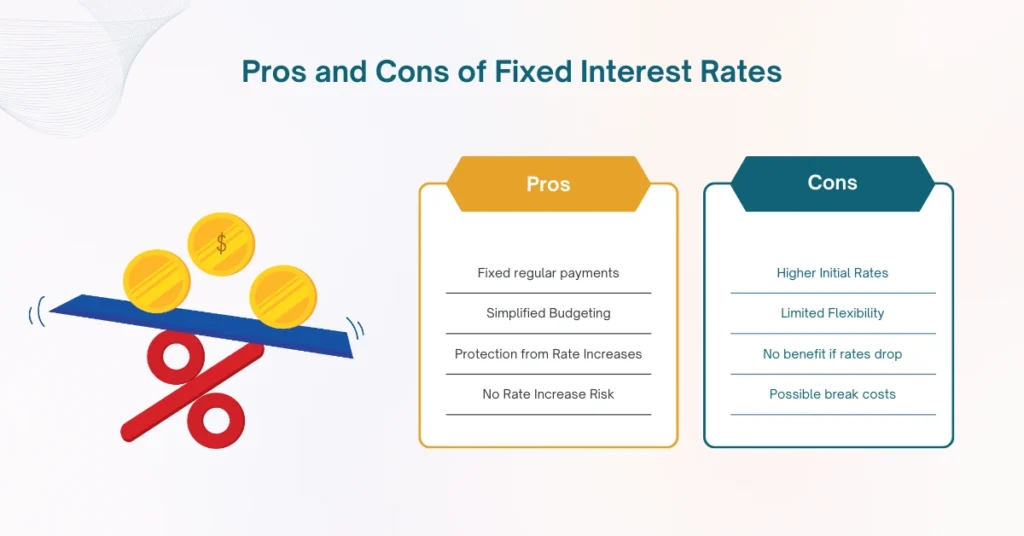
Pros and Cons of Fixed Interest Rates
Pros:
- Fixed weekly, fortnightly or monthly payments.
- Simplified budgeting and financial planning.
- Guarantee against increasing interest rates.
Cons:
- Often slightly higher initial rates.
- Minimal flexibility in terms of additional repayment or refinancing
- The rate will be the same even if the market rate drops.
- If for some reason you will have to sell or refinance property, this could come with hefty break costs, so always consider your future before fixing your loan.
If you are looking for stability and certainty, fixed rates could be a better option for you.
What is a Variable Interest Rate?
A variable can change with the central bank’s (RBA) movement in interest rate or a wider market fluctuation. The factors that can impact the movement may include current inflation rate, market confidence, employment rate etc..
Features of Variable Interest Rate
- Rate drop benefits: Repayment amounts decrease if the interest rate drops.
- Less predictability: Since variable rates can change, your ongoing repayments can be unpredictable.
- Higher risk: Significant increase in interest rate can adversely impact your household budget.
Pros and Cons of Variable Interest Rates
Pros:
- Potential savings when interest rates fall.
- Usually lower interest rates.
- More flexibility in repayments and refinancing.
- Some features come with variable interest rates like offset and redraw can save you thousands of dollars during the life of loan.
Cons:
- Repayments may increase unexpectedly.
- Due to fluctuating nature, budgeting is also more difficult.
- Increased vulnerability to market dynamics.
Difference Between Fixed and Variable Interest Rates
Predictability, flexibility, and exposure to risks are the primary differences between fixed and variable interest rates.
Under the category of fixed interest rates, a borrower would have confidence in constant repayments as well as the security against an increased rate of interest. However, they can lose out on savings in case market rates decrease.
Variable interest rates, on the contrary, enable the borrower to enjoy lower rates as the market goes down, and as the market goes up, the borrower may be caught in a situation where repayments are increased with a short period of notification.
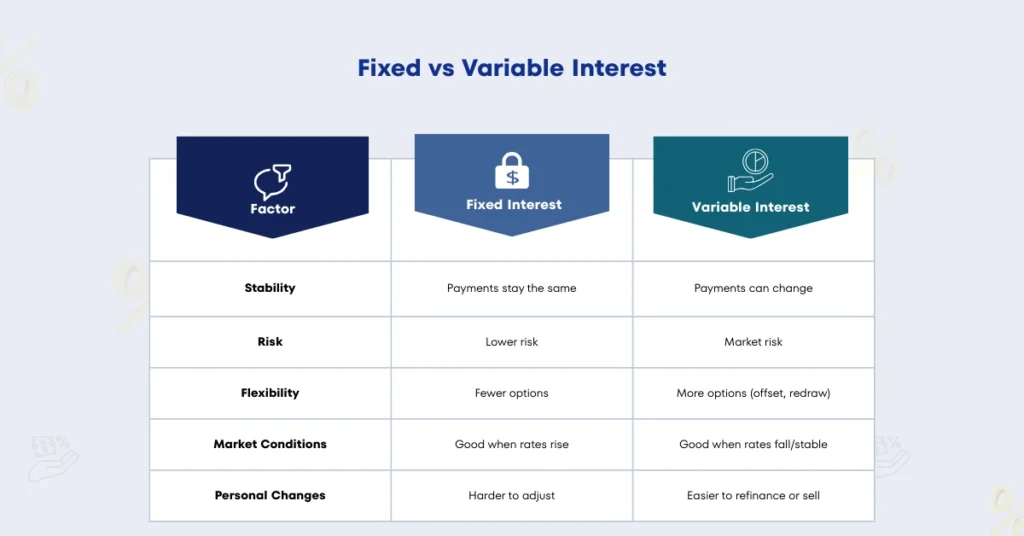
Fixed vs Variable Interest: A Practical Comparison
When comparing fixed and variable interest, consider the following factors:
- Stability: With fixed rates, you will have certainty. However, with variable rates, it could fluctuate anytime.
- Risk: A fixed rate minimizes the risk, and a variable rate exposes us to the market.
- Flexibility: Variable loans often permit a wider number of repayment options. It also can have some great features like offset account and redraw facility which can save you thousands of dollars.
- Market Conditions: Fixed rates suit well in an increasing market, whilst variable rates are appropriate in a declining or stable market.
- Change in personal situation: If you know your situation can change in near future and that includes refinancing, selling your property, job loss, separation or divorce etc., it is better to keep interest rate variable which can accommodate your change situation with lower cost.
Which Is Better: Fixed vs Variable Interest Rate?
There is no perfect answer to which is a better variable or fixed interest rate. It depends upon your financial situation, goals, and risk tolerance.
A fixed rate may suit you if:
- You prefer predictable repayments
- You have a tight budget
- You expect interest rates to rise
A variable rate may suit you if:
- You can handle repayment changes
- You want flexibility
- You believe rates may decrease
In many cases, borrowers also consider a combination approach, where you can split the loan strategically into fixed and variable to optimise the benefits.
Conclusion
Choosing between fixed and variable interest rates is a decision that will impact your household budget for a long time. Before you consider you will need to know how fixed interest rates or variable interest rates best suits your unique situation. While deciding it is important not only to consider what rates are now, but where market is heading, which direction inflation is heading? How is employment rate tracking? How can macro and micro economic trend will most likely affect short- and medium-term market and consumer confidence. A broader perspective will allow you to choose a type of interest rate that best meets your financial objectives and reduces your stress about your financial future.
FAQs
1. What are fixed and variable interest rates?
As name suggest in fixed interest rates, the rates are fixed and do not change for the duration of the fixed period, while in the variable rates, the rates change with time depending on the market.
2. How are variable interest rates different from fixed interest rates?
The main differences between fixed and variable interest rates are predictability, certainty, risk associated and features included.
3. What is the better variable or fixed interest rate for long term loans?
It relies on your personal and financial situation and ability to take risks. Fixed rates would be ideal for individuals who prefer certainty, whereas variable rates would work best for individuals who are happy to take some risks for better terms and possibly better rates too.
4. Is a sudden increase in variable interest rates possible?
Yes, the variable rates may rise in case there is an increase in market interest rates and consequently higher repayments.
5. Is the rate of fixed interest rates always higher?
Not necessarily, however they are more likely higher than variable rates unless you fixed them at the bottom end of the market cycle.