
When the Australian property market slows down, most investors react emotionally. They look at falling prices and assume they need to “do something quickly.” But inside a Self-Managed Super Fund (SMSF), quick decisions usually create long-term problems.
Buying pension-focused assets through SMSFs is governed by strict rules set out with the help of the Australian Taxation Office (ATO) and the Superannuation Industry (Supervision) Act 1993. That changes everything about how you should think during a downturn. The real question is simple: Should your SMSF hold, expand, or reduce property exposure based on structure, not emotion?
At Nepean Mortgage, our SMSF lending specialist, Krishna Upadhyay, has worked with investors in western Sydney and Penrith who face exactly this dilemma. Here is the structured framework we use with our clients.
What SMSF Property Investment Actually Means
An SMSF property investment allows your superannuation fund to directly own residential or commercial property. But it also comes with strict rules every trustee must follow:
- The fund must act solely for the retirement benefit or its members
- All transactions must follow arm’s-length pricing
- Investment decisions must meet compliance requirements under the SIS Act
- Liquidity must always remain available to meet fund obligations
Here’s what many trustees miss:
SMSF property is not about buying assets. It is about building a retirement system that can survive cycles.
If the structural foundation is weak, even a good property becomes a financial stress point during a downturn.

What a Market Downturn Actually Changes
A downturn does not automatically damage an SMSF. What it really does is expose weak planning. You usually see:
- Reduced property valuations
- Tighter lending conditions under LRBA structures
- Lower investor confidence
- Less refinancing options
But the most important shift is psychological. Trustees start reacting to valuations instead of fund health.
Let’s be clear: A valuation drop is not a real loss unless you sell the asset. But it still matters because it affects:
- borrowing capacity
- refinancing decisions
- Strategy for SMSF property investment direction
SMSF Property Investment Strategy (Your Control System)
A strong SMSF property investment strategy is not paperwork. It is the decision framework that controls how your fund behaves under pressure. It should answer three core questions:
1. Can the fund survive stress periods?
- Can it survive 3-6 months of vacancy?
- Can it handle interest rate increases?
- Can it pay expenses without distress selling?
If the answer to any of these is no, expansion is risky.
2. Is the fund overexposed?
Overexposure usually looks like:
- One property makes up the majority of the super balance
- One tenant as the sole income source
- A single asset class representing the entire strategy
This kind of concentration creates fragility during downturns.
3. Does it meet compliance intent?
The Australian Taxation Office requires all SMSF decisions to support retirement benefits only. That means emotional selling or panic buying rarely aligns with fund objectives.
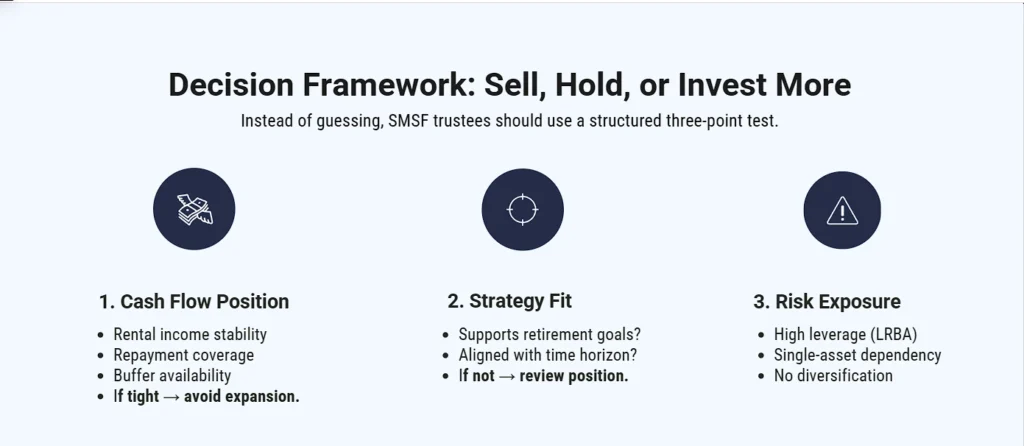
Decision Framework: Sell, Hold, or Invest More
Instead of guessing, SMSF trustees should use a structured three-point test.
1. Cash Flow Position
Check:
- rental income stability
- repayment coverage
- buffer availability
If cash flow is tight → avoid expansion.
2. Strategy Fit
Ask:
- Does this property still support retirement goals?
- Is it still aligned with the fund time horizon?
If not → review holding position.
3. Risk Exposure
High risk signs:
- high leverage under LRBA
- single-asset dependency
- no diversification
In real use, this usually fails because trustees underestimate liquidity pressure during downturns.
Is a Downturn a Chance to Buy?
A rough patch might turn out to be useful, though that depends on certain factors. Buying more property makes sense only when:
- Liquidity buffers are strong
- The existing debt is stable under the current LRBA structure
- Rental demand remains healthy
- Long-term holding is realistic
From experience, this only works when the SMSF is already stable. Not when it is under pressure.
A weak SMSF buying more property during a downturn increases risk, not opportunity. Stability must come first.
SMSF Lending Rules (LRBA Explained Simply)
Borrowing inside an SMSF uses a Limited Recourse Borrowing Arrangement (LRBA), regulated by the Australian Taxation Office.
Key structure of SMSF lending rules :
- One loan generally applies to one asset
- The asset is held in a bare trust
- SMSF receives income and capital growth benefits
- If the loan defaults, the lender can only recover the specific property, not other fund assets
An important note on rates: the SMSF lending rules themselves do not set interest rates for arm’s-length arrangements. However, the ATO does publish safe harbour interest rates that apply to related-party LRBAs each year. For commercial lender LRBAs, rates depend on individual lenders and market conditions.
At Nepean Mortgage, we compare SMSF loan options across our panel of 40+ lenders to ensure you are getting a competitive rate within the compliant structure.
Bare Trust Structure (Why It Exists)
A bare trust holds legal title to the property during the borrowing period. Its purpose is:
- To ensure compliance with LRBA rules
- To separate legal ownership from the SMSF until the debt is cleared
- To allow a clean transfer of the property into the SMSF’s name once the loan is repaid.
It is a simple structure with a strict compliance purpose. Setting it up correctly from the start avoids costly problems later.
Commercial Property Strategy for SMSF Investors
Commercial Property can be a powerful SMSF strategy when used correctly. It allows your fund to:
- Purchase commercial premises
- Lease it to a business (including related businesses in some cases)
- Create a stable long-term tenancy structure
Benefits:
- predictable rental income
- Reduced vacancy risk in strong leases
- long-term asset control for business owners
But rules matter:
- Rent must reflect the market value
- A formal lease agreement is required
- Strict compliance under SMSF rules applies
Common SMSF Mistakes in Downturns
Most SMSF failures do not come from markets. They come from decisions made under pressure.
Common mistakes:
- Overleveraging under an LRBA without adequate cash buffers
- Ignoring liquidity requirements until a crisis forces action
- Emotional selling during valuation drops
- Poor diversification
- Failing to update the SMSF property investment strategy document annually
Practical Case: Penrith SMSF Investor During a Downturn
Here is a real-world scenario we see with SMSF clients in the Western Sydney region.
Situation:
- SMSF holds one residential property in Western Sydney
- Property value falls by eight percent during the market downturn
- Interest rates go up, and monthly repayments go up
- Rental income remains stable, and the tenant has not left
Pressure: The trustee considers selling due to fear of further value drop
Analysis:
- Cash flow remains stable and covers all repayments
- No compliance issue exists with the ATO
- The long-term strategy is still valid
Decision: The SMSF holds the asset.
Outcome: Market stabilizes over time, and valuation recovers. The key issue was never the property. It was emotional decision-making.
When Selling Actually Makes Sense
Selling is not wrong, but it just needs to be justified by the fund’s position, not market sentiment. Selling is appropriate when:
- The SMSF cannot meet pension obligations without liquidating assets
- Liquidity has become critically low, and expenses cannot be covered
- The asset no longer fits the fund’s retirement strategy or the time horizon
- The portfolio needs rebalancing to reduce overexposure
- The fund is moving into the retirement phase and requires cash conversion
- The asset has grown in value significantly and the trustee is considering buying 2 or more assets instead of one.
A market downturn alone is not a sufficient reason to sell. The fund’s structural position is what matters.
How Nepean Mortgage Supports SMSF Investors
Nepean Mortgage works with SMSF trustees to structure lending decisions properly. We understand the pressure SMSF trustees face during a downturn, not just from a lender’s perspective, but as an investor.
We support SMSF trustees across Penrith, Western Sydney, and Australia with:
- SMSF loan structuring under LRBA rules
- Refinancing to improve cash flow stability
- Lender comparison across 40+ banks and non-bank lenders for SMSF loans
- Coordination with accountants for compliance alignment
- Ongoing mortgage reviews to ensure your loan remains competitive
Ready to review your SMSF lending position? Contact Krishna at Nepean Mortgage today.
Conclusion
A downturn does not break SMSF property investing. Poor structure does. A strong SMSF property investment strategy focuses on liquidity discipline, compliance under ATO rules, long-term retirement planning, and controlled leverage under LRBA.
When those foundations are strong, market cycles become manageable, not dangerous.
FAQs
1. Should you sell SMSF property during a downturn?
Not usually. A drop in value isn’t a real loss unless you sell, so the better question is whether your fund can comfortably hold the property. If cash flow is steady, holding often makes more sense than reacting to short-term market movement.
2. Can you invest more in SMSF property during a downturn?
Yes, but only if your fund is in a strong position. You need solid cash reserves and manageable debt before taking on more. Most problems happen when people expand too early.
3. What are the key SMSF lending rules for property?
Borrowing must follow the LRBA rules set by the Australian Taxation Office. Borrowing money links directly to a single building. Should problems arise, the bank gets just that property – nothing more. This setup guards the pool of cash while shrinking room to move.
4. How much extra cash should a self-managed super fund hold?
Up to Six months saved-up cash keeps things steady when loans come due, vacancies stretch on, or sudden costs show their face out of nowhere. Without that cash buffer, even a small issue can force a bad decision.
5. When should you actually sell an SMSF property?
Selling makes sense when the fund is under pressure, not just because prices dip. If liquidity is tight or the property no longer fits your strategy, then it’s worth reviewing. Otherwise, holding is often the steadier path.
General Advice Disclaimer
Getting around SMSF rules isn’t straightforward since everyone’s situation differs. Speaking with a qualified financial planner, certified tax agent, or SMSF expert helps clarify what makes sense for you before moving forward. Licensed under MFAA number 681034, Nepean Mortgage operates under Credit Representative number 572369, and ABN 57 689 443 721.