
If you live in Penrith, St Mary’s, across Western Sydney or even greater Australia, chances are your mortgage has started to feel heavier in 2026. It’s not just the numbers. It’s the feeling when your repayment goes out each month, and you notice there is less left behind. Every RBA announcement now feels personal. And that is why one question keeps coming up in conversations with homeowners: Should you fix your home loan rate?
As Nepean mortgage we work closely with local borrowers, we are seeing more families focus on one thing over everything else- stability. Not predictions, not guesses, but something they can actually plan their life around.
Why are Interest Rates Still Under Pressure in 2026
What drives most changes in home loans in Australia is the Reserve Bank of Australia. It modifies the cash rate to help manage the inflation rate and stabilize the economy. As long as the inflation rate is maintained at high levels, the interest rates will remain high. The Australian Bureau of Statistics shows that inflation (measured through CPI) has remained well above the long-term target range of 2% to 3% in recent reporting periods.
That matters because:
- Higher inflation means higher interest rates
- Higher interest rates mean higher home loan repayments
- Higher repayments mean tighter household budgets
This is the pressure many Australian families are feeling right now.
What the latest RBA Environment Means for Homeowners
When the Reserve Bank of Australia (RBA) changes the interest rate, there will be a corresponding adjustment to home loan interest rates by the banks within days. An increase or decrease of even 0.25 percent is seemingly insignificant. But the impact is very significant when translated into dollar figures.
For instance:
- On a $600,000 loan, repayments can increase by around $100 per month
- On a $750,000 loan, the impact is even higher, depending on the structure
That does not appear too much on its own. But within the span of one year, the cost accumulates to thousands of dollars, influencing people’s budgets. This is the reason why many homeowners begin evaluating their possibilities instead of just waiting.
So, Should You Fix Your Home Loan Rate?
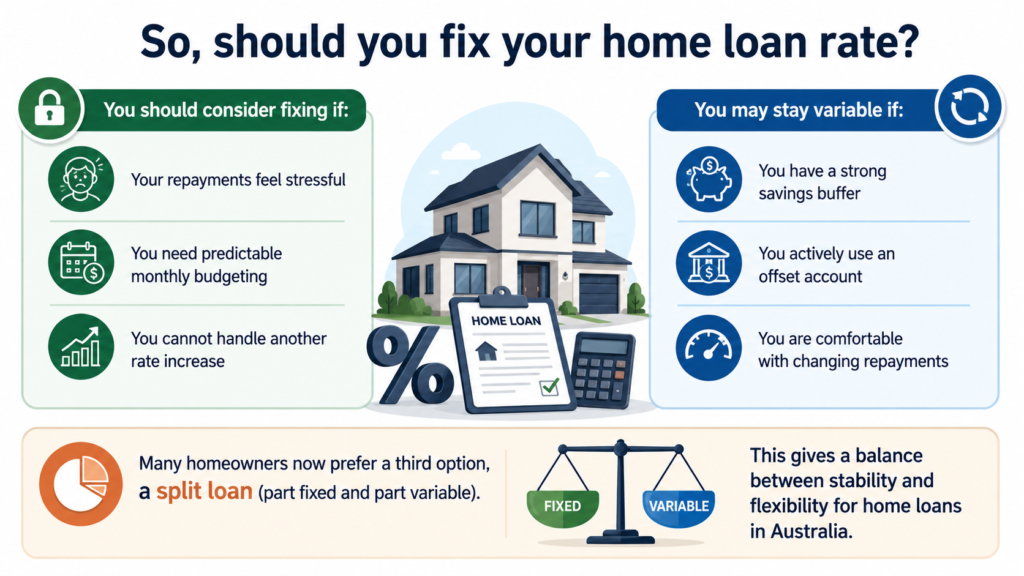
You may consider fixing your loan if:
- Your repayments feel stressful
- You need predictable monthly budgeting
- Another rate rise would strain your finances
You may stay variable if:
- You have a strong savings buffer
- You actively use an offset account
- You are comfortable with changing repayments
Many homeowners now prefer a third option, a split loan (part fixed and part variable). This gives a balance between stability and flexibility for home loans in Australia.
Fixed vs Variable Home Loans
Before deciding whether you should fix your home loan interest rate, you need to understand how both options actually behave.
1. Fixed Home Loan (Stability choice)
A fixed home loan locks your interest rate for a set period, usually 1-5 years.
What this means:
- Your repayments stay the same
- Your budget becomes predictable
- You are protected from future RBA increases
Downsides:
- Less flexibility
- Limited extra repayments
- Break costs if you exit early
This suits people who want stability and reduced financial stress.
2. Variable Home Loan (Flexible choice)
A variable loan changes based on market conditions and RBA movements.
What this means:
- Repayments can go up or down
- You may benefit if rates fall
- You can use offset accounts
Downsides:
- Less predictable budgeting
- Higher stress during rate rises
This suits people who want flexibility and long-term savings potential.
Penrith Real-life Scenario
A couple in Penrith borrowed a loan of $700,000. Initially, the repayments were not difficult. But after several RBA increases, their monthly budget became tight. They started feeling pressure on monthly expenses, less savings at the end of each month, and stress before every RBA announcement. One partner wanted a full fix for certainty. The other wanted variables for flexibility and offset benefits. After speaking with a Nepean mortgage brokers, they chose a split loan:
- 75% fixed
- 25% variable
After splitting the loan:
- Repayments became stable
- Financial stress reduced
- They kept the offset account benefits
- Their budget became easier to manage
This is now a very common structure across Western Sydney.
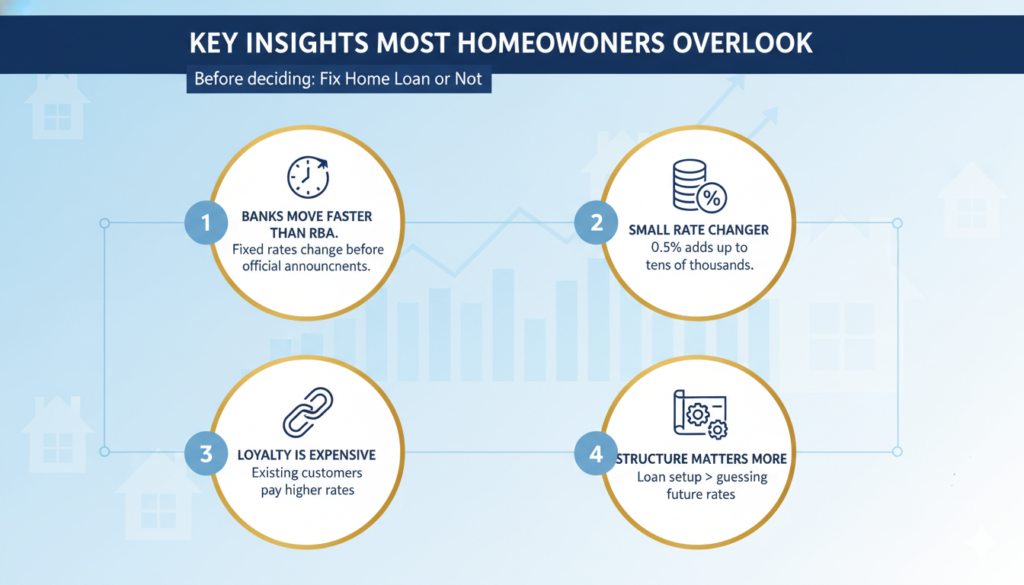
Key Insights Most Homeowners Overlook
Before deciding fix home loan or not, here are some important truths:
1. Banks move faster than RBA decisions
Fixed rates often change before official RBA announcements.
2. Small rate changes matter long-term
Even a 0.5% difference can add up to tens of thousands over time.
3. Loyalty is expensive
Existing customers often pay higher rates than new borrowers.
4. Structure matters more than prediction
The right loan setup is more important than guessing future rates.
Why Nepean Homeowners Are Reviewing Loans
In Penrith, St Mary’s, and the greater Western Sydney area, more homeowners are considering their current loan than those who continue to leave their loan as is.
We are seeing three clear trends:
- More refinancing home loan conversations with brokers
- More comparisons between lenders
- More focus on reducing long-term interest costs
The reason for this is the pressure that people feel when paying for living costs, which makes mortgages a crucial decision. In fact, many homeowners find their mortgage their largest financial obligation, so even minor differences in interest rates count.
Conclusion
If you are still confused about “should you fix your home loan rate”, here is the simplest way to think about it: a fixed loan gives stability, a variable loan offers flexibility, whereas you can find balance when you split your loan. That’s why there is no perfect answer that fits everyone. But there is always a right structure for your situation. As a Nepean mortgage broker, the most important advice we can give is simple: don’t guess, understand your numbers, know your risk level, and then choose a structure that protects your home and your financial peace. Because at the end of the day, a home loan is not just a product. It is your family’s foundation.
Still unsure whether you should fix your home loan rate? Talk to Nepean Mortgage for a quick review of your current loan and see what actually suits your situation today.
FAQs
Is there any value in fixing my mortgage interest rate?
Fixing your rate can be valuable if predictable repayments are important to your budget. If you cannot afford any more rises in payments, then that is definitely something good to do, but if you wish to repay your loan quicker through an offset account, the opposite could be done.
What is the 1% rule for refinancing?
Some borrowers use this as a general benchmark. It suggests that if you can find a new interest rate that is 1% lower than your current one, the savings you make will usually be much bigger than the fees you pay to switch banks. While not part of the RBA’s official data, it is a great “rule of thumb” to discuss with your broker. There can be sweeteners like cashback offered by the lenders to win your business worth discussing with your broker.
Do I lock in a rate now or wait?
It all depends on how much money you have and your risk tolerance. If increasing interest rates and the actions of the RBA make it difficult for you to forecast repayment amounts, then opting for a fixed interest rate will provide you with peace of mind and eliminate a lot of worry. However, if you have some solid financial buffer and expect interest rates to fall in the future, remaining variables may be beneficial.
What happens after 2 years of a fixed rate?
Once your fixed rate period ends, your loan usually moves onto the lender’s standard variable rate unless you renegotiate or refinance. This can sometimes result in higher repayments if interest rates have increased during your fixed term. It is always a good idea to review your loan a few months before it ends so you have time to plan your next step.
Disclaimer: The above article is general in nature. Readers are advised to consult professional advice for individual circumstances.
Written by Australian Mortgage Expert


