
The Australian dream of owning a home is becoming increasingly difficult. As property prices in key cities such as Sydney, Melbourne and Brisbane keep rising, the 20 per cent deposit has become a giant challenge to save. Market growth can be seen to outpace the years of saving by many first-home buyers.
But there is a strategic route that can enable you to skip the ten years of saving and enter the market several years earlier. A guarantor home loan is an effective financial instrument that will help you fill the gap between what you have saved and what you want to own. The guide is aimed at first-home buyers and their families to learn how to purchase sooner, prevent LMI, and gain a foothold in the Australian property market.
What is a Guarantor Home Loan in Australia?
A guarantor home loan is a mortgage in which a third party, typically a close family member, provides some of the equity in their own property as added security to your loan.
This is commonly known as a family guarantee loan or a parental guarantee mortgage in the lending world. Your guarantor gives you a paper guarantee instead of you giving the full 20% cash deposit. This greatly lowers the risk to the lender, and you can get into the market with a much smaller deposit or even no deposit at all.
How Does a Guarantor Home Loan Work?
The general process of how this loan works is crucial to both the borrower and the guarantor. The general procedure is as follows:
- The Application: The buyer submits a home loan application but does not have the 20% deposit to avoid LMI.
- The Guarantee: A relative pledges a certain amount of his or her home equity to the lender as security.
- LVR Calculation: The lender looks at the combined security. By adding the guarantor’s equity, lenders assess the loan as if you have a lower loan-to-value ratio (LVR), often around 80%, which helps you avoid LMI.
- Repayment Responsibility: It is a myth that the guarantor assists in making monthly payments. The borrower is 100% responsible for all repayments. The guarantor is merely a back up in case the borrower defaults and the property is sold at a loss.

Who Can Be a Guarantor?
Lenders are strict about who can provide security. Generally, the guarantor loan requirements dictate that the person must be a close relative. This typically includes:
- Parents: The most common scenario
- Siblings: Many lenders allow brothers or sisters
- Grandparents: Occasional exceptions are made for grandparents with high equity
Beyond the relationship, the specific guarantor loan requirements focus on the guarantor’s financial health. To be accepted by the lender, they should own property in Australia with adequate equity, have a stable financial position, and have a good credit history.
Benefits of a Guarantor Home Loan for First Home Buyers
A guarantor home loan has several strategic benefits:
- Buy Property Sooner: You need not wait years to save a six-figure deposit.
- Avoid LMI: LMI can be between 15,000 and 35,000 on an average Australian home. A guarantee eliminates this cost.
For example, according to ‘Home Loan Experts’ LMI estimates, LMI on a $1,000,000 property can exceed $34,000, a cost completely avoided with a guarantor structure.
- Borrow up to 100%: You can finance the purchase price and even the stamp duty and legal fees.
- More Borrowing Power: As the security increases, lenders can provide more competitive interest rates, typically available to high deposit borrowers.
Risks and Considerations
Although the advantages are evident, a guarantor home loan comes with serious financial risk.
- For the Borrower:
You are taking on a larger loan. A 100% loan means higher monthly repayments than a loan where you provided a 20% cash deposit. You are also financially linked to your family member, which requires high levels of trust.
- For the Guarantor:
The greatest risk is that in case the borrower defaults and the house is sold below the amount due, the lender can take the guaranteed amount out of you. This may even result in selling your own home in the worst-case scenario. Because of this, Australian lenders require guarantors to seek independent legal and financial advice before signing.
Types of Guarantor Loan Australia
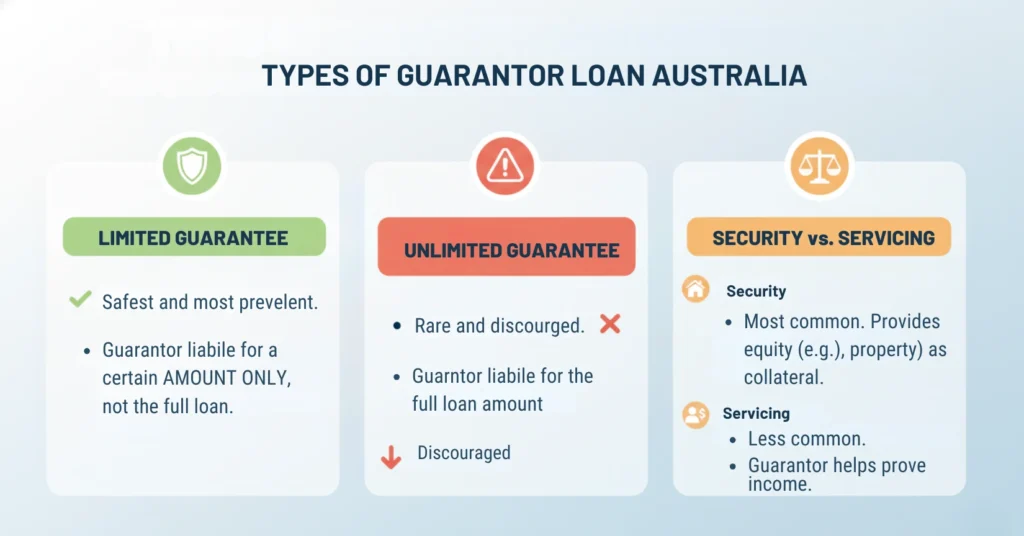
Not all guarantees are the same. In guarantor loan Australia structures, you will mostly encounter the following:
- Limited Guarantee: This is the safest and most prevalent. A guarantor is not liable for the full amount of the loan but only for a certain amount.
- Unlimited Guarantee: This is rare and very discouraged since the guarantor is liable for the full loan amount.
- Security vs. Servicing: Most are security guarantees providing equity. A servicing guarantee involves the guarantor helping to prove income, though this is less common today.
How to Remove a Guarantor from a Home Loan
A guarantor home loan is not forever. The goal is to remove the guarantor as soon as possible, typically within 2 to 5 years. This can happen when:
- Loan Balance Drops: Through regular repayments, you owe less than 80% of the home’s value.
- Property Value Increases: If the market rises, your equity grows.
- Refinancing: You can refinance into a standard loan once you hit the 20% equity mark.
Guarantor Home Loan Eligibility Criteria
To meet the standard guarantor loan requirements, you still need to be a strong candidate on your own. Lenders will look for:
- Stable Income: Full-time or regular part-time work.
- Good Credit Score: Indication of a responsible borrower.
- Australian Residency: Usually limited to citizens or permanent residents.
- Property Type: The home must be a standard residential property, some small apartments or rural land may be excluded.
Comparison: The First Home Buyer Landscape
| Feature | Standard Loan | Low Deposit + LMI | Guarantor Loan |
| Deposit Required | 20% | 5% – 10% | 0% – 5% |
| LMI Cost | $0 | High | $0 |
| Interest Rate | Lower | Higher | Competitive |
| Speed to Market | Slow | Moderate | Fast |
Interestingly, according to SBS housing scheme analysis, government-backed schemes now allow buyers to enter the market with as little as a 5% deposit, reinforcing the growing trend towards low-deposit solutions like guarantor loans.
Case Study
A first time homebuyer in Sydney makes $85,000 a year. They saved $30,000 but need over $120,000 for a typical deposit. With the support of a parental guarantor, they secured a $600,000 property without paying LMI.
By using a limited guarantee:
- They entered the market years earlier
- Avoided over $20,000 in LMI
- Built equity faster
Within three years, property growth and repayments allowed them to refinance and remove the guarantor.
Conclusion
A guarantor home loan is a good option when you are earning a stable income but have a hard time saving, as you pay rent. It is ideal for those with supportive family members who have significant equity in their homes. However, it is not ideal if your family relationship is strained or if you are not confident in your ability to manage the higher repayments of a 100% loan.
Struggling to save a 20% deposit? A guarantor home loan could help you enter the market sooner. Speak with the experts at Nepean Mortgage obligation free borrowing assessment and personalised loan strategy tailored to your situation.
FAQs
Can I buy it with no deposit?
Yes, if the guarantor home loan covers the full 100% of the purchase, plus costs like stamp duty.
Can friends be guarantors?
In the landscape of guarantor loan products in Australia, most lenders strictly consider immediate family only.
What will be the case in case of missed repayments?
The borrower will be initially dealt with by the lender. In case of the default persisting, they can turn to the guarantor to pay the particular guaranteed amount.
Are my parents eligible to be guarantors when they are retired or pensioners?
Yes, but that is dependent on the lender. The primary guarantor loan requirement in this case shifts from income to equity. As long as your parents have sufficient usable equity.


