
Australia’s property market is evolving once more. Rising interest rates, property prices, and a lack of supply are all influencing investors’ opinions about property investment. For all those potential investors who live in Sydney, and around Penrith, Kingswood, Werrington, and Marsden Park, one very common question is: Will changes in taxation impact your approach to property investment?
At Nepean Mortgage, we have extensive experience with locals, first-time buyers, and property investors. No one really wants complicated terms when it comes to taxes. They want information that is easy to understand and helps them plan wisely.
Why Investors Are Talking About Tax Changes Again
Property investing has always been a major part of wealth building in Australia. Currently, around 51% of Australian adults own investments in stocks, property, and managed funds, and not in commodities trading as per the Australian Bureau of Statistics (ABS).
Two major taxation principles guide investment decisions; these include negative gearing and Capital Gains Tax (CGT). Recently, discussions around the negative gearing changes 2026 have increased interest among investors.
What is Negative Gearing and Why Does it Matter?
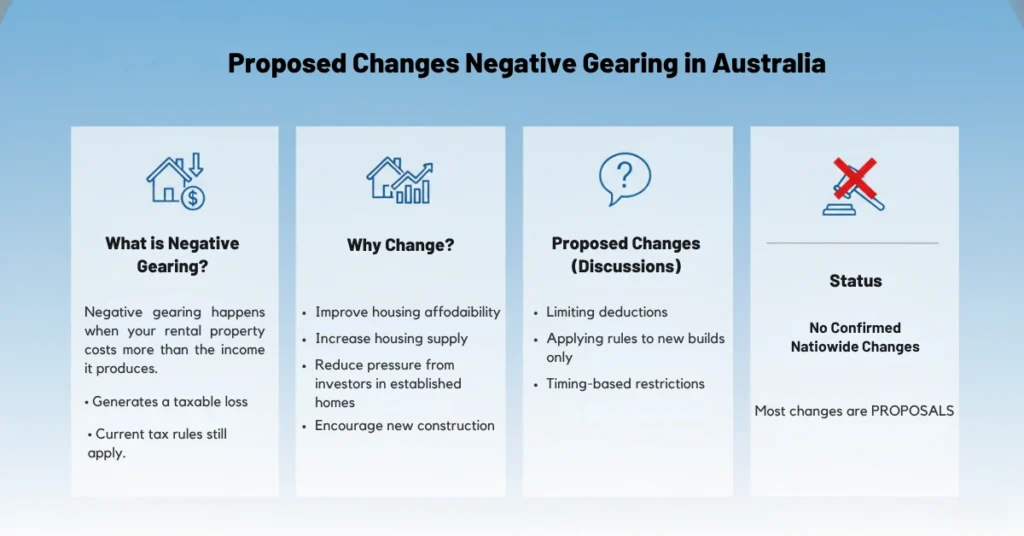
Negative gearing happens when your rental property costs more than the income it produces. Here is an example:
- Income from rent: $32,000
- Costs: $40,000
- Loss: $8,000
Losses may be deducted from taxable income as per rules set by the Australian Taxation Office. This is why many Australians use negative gearing while waiting for long-term property growth.
Negative gearing can reduce tax pressure in early years, help manage mortgage repayments, support long-term investment holding, and make high-value properties more affordable to hold. At the same time, there are various risks involved, including high interest rates and losses, vacancy leading to lower yields, increased maintenance costs, and thus any discussion regarding negative gearing is always kept under close watch by Australian investors.
If you’re considering whether investment loan is right for your situation, understanding your tax position is an essential first step and something we can you work through before you apply.
What are the Proposed Changes to Negative Gearing?
Affordable housing has been a common political issue in Australia for some time now. The idea behind the negative gearing changes 2026 discussions is to:
- improve housing affordability
- increase housing supply
- reduce pressure from investors in established homes
- encourage new construction
However, no nationwide law has removed negative gearing. Current tax rules still apply today. And, most changes to negative gearing being discussed are proposals, not confirmed policy. This distinction matters a lot for investors.
Established Homes vs New Builds
One of the biggest policy discussions focuses on property type. Some proposals include banning benefits for older homes, encouraging new home builds, and helping with off-plan construction. Australia continues to face a shortage of available housing supply.
Population growth across western Sydney suburbs like Penrith, St Mary’s, Werrington, and Marsden Park is also expected to keep rental demand strong.
Comparison of Taxes: The Old vs. The New Regime
Example of Commonly Discussed Reform Proposals (Not Current Law)
Here’s how these proposals could affect different types of investment properties if they become law.
Property Investment Tax Comparison
Note: These proposed rules and reforms will only be applicable after the implementation of the new rules; as of now, they are under discussion and being reviewed by the government Authorities.
| Investment Property Category | Negative Gearing (proposed discussions) | Capital Gains Tax (potential reform) |
| Established Property | Losses may be limited to offsetting:residential rental income, orfuture residential capital gains. | may move to an indexation method based on CPI, with a proposed 30% minimum tax on real capital gains. |
| New-Build Property (Adds to housing supply) | Fully Deductible: Losses may offset your regular salary and wage income. | Investor Choice: Choose the 50% discount or the new indexation rules. |
| Grandfathered Property | Fully Exempt: may retain old negative gearing benefits against salary. | Split Gains: 50% discount on capital gains until the proposed date and indexation on newer gains. |
| Your Primary Family Home (Main Residence) | Not applicable. | 100% Tax-Free: The main residence exemption will remain unchanged. |
Understanding Capital Gains Tax in Australia and CGT Discount Australia
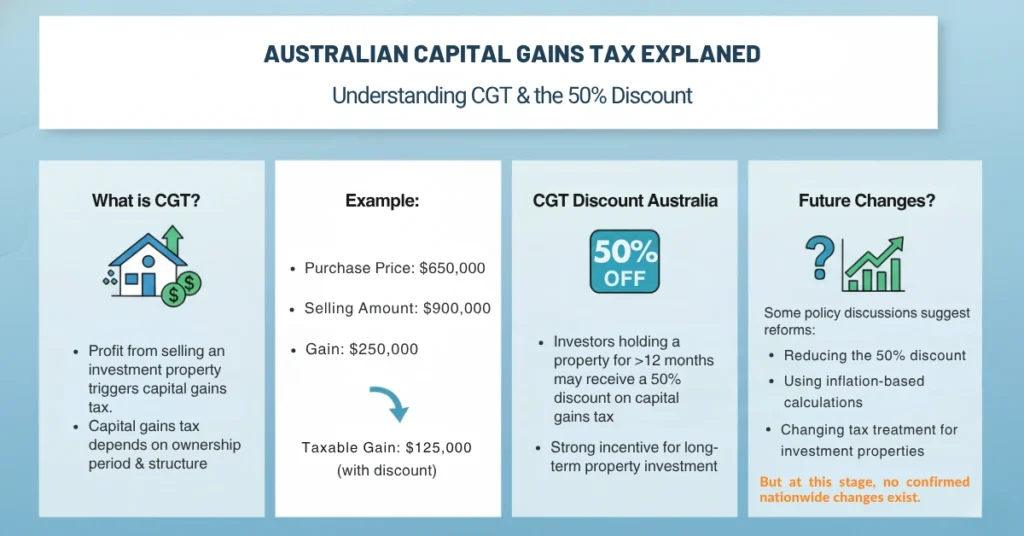
Profit from selling an investment property triggers capital gains tax. That profit may be taxed depending on the ownership period and structure.
Example:
- Purchase Price: $650,000
- Selling Amount: $900,000
- Gain: $250,000
That profit may be taxed depending on the ownership period and structure.
As per the Australian taxation office, investors who hold a property for more than 12 months may receive a 50% discount on capital gains tax. This is known as the CGT discount in Australia. It remains one of the strongest incentives for long-term property investment. The capital gains tax discount australia system encourages investors to hold assets longer rather than sell quickly.
Could Capital Gains Tax Rules Change?
Some policy discussions have suggested future reforms, such as:
- Reducing the 50% discount
- Using inflation-based calculations
- Changing tax treatment for investment properties
But at this stage, no confirmed nationwide changes exist.
How These Changes Could Affect Borrowing Power
Banks do not only look at income. They also look at expenses, rental returns, tax position, and risk profile. If tax rules change in the future, lenders may adjust how they calculate borrowing capacity. That is why investors should:
- Review loans early
- Avoid over-leveraging
- Plan cash flow carefully
Small changes in tax policy can have a big effect on loan approvals.
Example Scenario Based on Proposed Laws
Let’s assume that these capital gains and negative gearing laws were implemented. In this scenario, we can compare these two investors:
Investor 1: Older Property
Suppose an investor named Mark buys an older home in Kingswood under a future policy model where some proposed reforms were introduced. Because of high interest rates, his property runs at an annual cash flow loss of $9,000. In this scenario, his $9,000 loss could potentially be quarantined and carried forward against future investment income or capital gains.
Investor 2: New Build
Let’s assume another investor, Sarah, purchased a new townhouse in Werrington for $810,000. Her property also records an annual cash flow loss of $9,000. Under proposed policy models, newly built properties may continue receiving full negative gearing benefits to support housing supply. In this hypothetical scenario, her investment loss may remain deductible against her salary income, which could potentially improve her overall cash flow position.
Tips to Invest Smartly
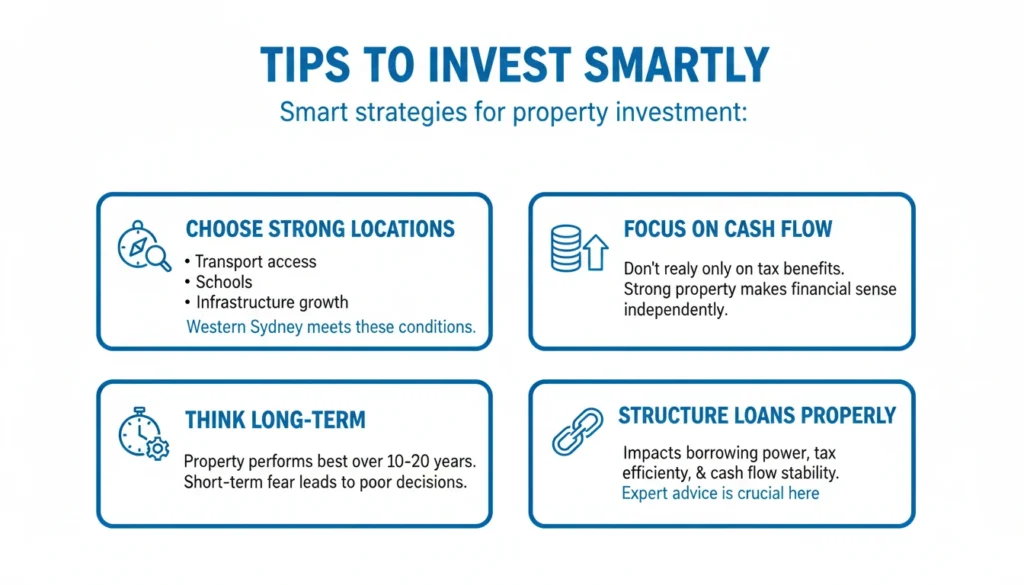
These are some smart strategies for investment:
- Choose strong locations: You should look for transport access, schools, hospitals, and infrastructure growth. Western Sydney continues to meet these conditions.
- Focus on cash flow: Do not rely only on tax benefits. A strong property should still make sense financially even without aggressive tax advantages.
- Think long-term: Property works best over 10 to 20 years, as short-term fear leads to poor decisions.
- Structure loans properly: Loan structure can impact borrowing power, tax efficiency, and cash flow stability. This is where expert advice becomes important.
Why Work With Nepean Mortgage
At Nepean Mortgage, we help Australian investors understand how changes around negative gearing and capital gains tax in Australia can affect both their tax position and their borrowing power.
- Our loan structures are based on how lenders actually assess investors today, including rental income treatment and policy shifts.
- We help set up offset accounts, split loans, and equity strategies that support long-term property growth, not just initial approval.
- We understand how lending conditions and property demand work across Penrith, Kingswood, and surrounding growth suburbs.
- We don’t just help you get a mortgage- we help you structure it so it still works as conditions change over time.
We don’t just focus on short-term tax benefits. We look at whether your investment still works if lending rules or tax settings change in the future.
Conclusion
The discussion about Negative Gearing and Capital Gains Tax Changes in Australia clearly shows how Australia is trying to find the right balance between the two aspects- affordable housing and incentive to invest. Even now, with changes being discussed, old rules still apply across the country. That’s why, it is very important that the real estate investors think ahead of time, and that they focus on cash flows, good location, and make sensible decisions, keeping themselves updated with authentic sources such as the Australian Taxation Office, wherever required.
Unsure how market changes affect your borrowing power? Speak with Nepean Mortgage for practical advice tailored to investors. We’ll help you understand your position, compare lending options, and move forward with confidence.
FAQS
Are my current investment properties hit by these new rules?
The proposed changes haven’t been passed into law yet. If and when they are, properties purchased before the cut-off date are expected to retain their existing negative gearing and CGT treatment. Check the ATO website for the latest confirmed position.
What falls under the category of new builds in 2026?
It encompasses house-and-land deals, off-plan apartments, and big constructions that result in new dwellings on lands that were previously empty.
Can I utilize my rental losses against rental income??
Some proposed reform models suggest that quarantined losses from established properties could potentially be offset against future rental profits or capital gains. However, no nationwide changes have been officially confirmed.
Will the capital gains tax discount in Australia rule change?
There are talks about implementing a capital gain tax discount in Australia, but there is no official confirmation of that yet.
Disclaimer: The above article is general in nature. Readers are advised to consult professional advice for individual circumstances.
Written by Australian Mortgage Expert